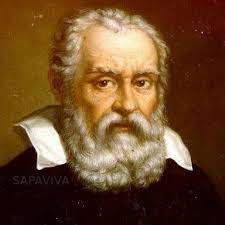
Galileo Galilei was an Italian astronomer, physicist and engineer, sometimes described as a polymath, from Pisa. Galileo has been called the "father of observational astronomy", the "father of modern
physics", the "father of the scientific method", and the "father of modern science".Galileo studied speed and velocity, gravity and free fall, the principle of relativity, inertia, projectile motion and also worked in applied science
and technology, describing the properties of pendulums and "hydrostatic balances". He invented the thermoscope and various military compasses, and used the telescope for scientific observations of celestial objects. His contributions
to observational astronomy include telescopic confirmation of the phases of Venus, observation of the four largest satellites of Jupiter, observation of Saturn's rings, and analysis of sunspots.
Galileo's championing of Copernican heliocentrism (Earth rotating daily and revolving around the sun) was met with opposition from within the Catholic Church and from some astronomers. The matter was investigated by the Roman Inquisition
in 1615, which concluded that heliocentrism was foolish, absurd, and heretical since it contradicted Holy Scripture.
Galileo later defended his views in Dialogue Concerning the Two Chief World Systems (1632), which appeared to attack Pope Urban VIII and thus alienated both the Pope and the Jesuits, who had both supported Galileo up until this point.
He was tried by the Inquisition, found "vehemently suspect of heresy", and forced to recant. He spent the rest of his life under house arrest. During this time, he wrote Two New Sciences (1638), primarily concerning kinematics and
the strength of materials, summarizing work he had done around forty years earlier.

Refracting Telescope
A refracting telescope (also called a refractor) is a type of optical telescope that uses a lens as its objective to form an image (also referred to a dioptric telescope). The refracting telescope design was originally used in spy glasses
and astronomical telescopes but is also used for long-focus camera lenses. Although large refracting telescopes were very popular in the second half of the 19th century, for most research purposes, the refracting telescope has been
superseded by the reflecting telescope, which allows larger apertures. A refractor's magnification is calculated by dividing the focal length of the objective lens by that of the eyepiece.
Refracting telescopes typically have a lens at the front, then a long tube, then an eyepiece or instrumentation at the rear, where the telescope view comes to focus. Originally, telescopes had an objective of one element, but a century
later, two and even three element lenses were made. Refracting telescope is a technology that has often been applied to other optical devices, such as binoculars and zoom lenses/telephoto lens/long-focus lens.