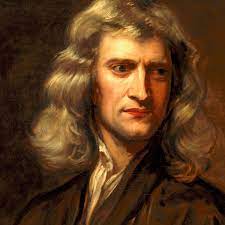
Sir Isaac Newton PRS (25 December 1642 – 20 March 1726/27) was an English mathematician, physicist, astronomer, theologian, and author (described in his time as a "natural philosopher") who is widely
recognised as one of the greatest mathematicians, physicists and most influential scientists of all time. His book Philosophiæ Naturalis Principia Mathematica (Mathematical Principles of Natural Philosophy), first published in 1687,
established classical mechanics. Newton also made seminal contributions to optics, and shares credit with German mathematician Gottfried Wilhelm Leibniz for developing infinitesimal calculus.
In Principia, Newton formulated the laws of motion and universal gravitation that formed the dominant scientific viewpoint until it was superseded by the theory of relativity. Newton used his mathematical description of gravity to derive
Kepler's laws of planetary motion, account for tides, the trajectories of comets, the precession of the equinoxes and other phenomena, eradicating doubt about the Solar System's heliocentricity. He demonstrated that the motion of objects
on Earth and celestial bodies could be accounted for by the same principles. Newton's inference that the Earth is an oblate spheroid was later confirmed by the geodetic measurements of Maupertuis, La Condamine, and others, convincing
most European scientists of the superiority of Newtonian mechanics over earlier systems.

Newton's First Laws of Motion
Newton’s first law states that if a body is at rest or moving at a constant speed in a straight line, it will remain at rest or keep moving in a straight line at constant speed unless it is acted upon by a force. In fact, in classical
Newtonian mechanics, there is no important distinction between rest and uniform motion in a straight line; they may be regarded as the same state of motion seen by different observers, one moving at the same velocity as the particle
and the other moving at constant velocity with respect to the particle. This postulate is known as the law of inertia. The law of inertia was first formulated by Galileo Galilei for horizontal motion on Earth and was later generalized
by René Descartes. Although the principle of inertia is the starting point and the fundamental assumption of classical mechanics, it is less than intuitively obvious to the untrained eye. In Aristotelian mechanics and in ordinary experience,
objects that are not being pushed tend to come to rest. The law of inertia was deduced by Galileo from his experiments with balls rolling down inclined planes.

Newton's Second Laws of Motion
Newton's second law of motion pertains to the behavior of objects for which all existing forces are not balanced. The second law states that the acceleration of an object is dependent upon two variables - the net force acting upon the
object and the mass of the object. The acceleration of an object depends directly upon the net force acting upon the object, and inversely upon the mass of the object. As the force acting upon an object is increased, the acceleration
of the object is increased. As the mass of an object is increased, the acceleration of the object is decreased.

Newton's Third Laws of Motion
Newton’s third law states that when two bodies interact, they apply forces to one another that are equal in magnitude and opposite in direction. The third law is also known as the law of action and reaction. This law is important in analyzing
problems of static equilibrium, where all forces are balanced, but it also applies to bodies in uniform or accelerated motion. The forces it describes are real ones, not mere bookkeeping devices. For example, a book resting on a table
applies a downward force equal to its weight on the table. According to the third law, the table applies an equal and opposite force to the book. This force occurs because the weight of the book causes the table to deform slightly
so that it pushes back on the book like a coiled spring.
If a body has a net force acting on it, it undergoes accelerated motion in accordance with the second law. If there is no net force acting on a body, either because there are no forces at all or because all forces are precisely balanced
by contrary forces, the body does not accelerate and may be said to be in equilibrium. Conversely, a body that is observed not to be accelerated may be deduced to have no net force acting on it.