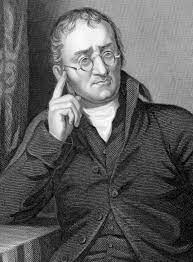
John Dalton (6 September 1766 – 27 July 1844) was an English chemist, physicist and meteorologist. He is best known for introducing the atomic theory into chemistry, and for his research into colour
blindness, sometimes referred to as Daltonism in his honour.
John Dalton was born into a Quaker family from Eaglesfield, near Cockermouth, in Cumberland, England. His father was a weaver. He received his early education from his father and from Quaker John Fletcher, who ran a private school in the
nearby village of Pardshaw Hall. Dalton's family was too poor to support him for long and he began to earn his living, from the age of ten, in the service of wealthy local Quaker Elihu Robinson.
When he was 15, Dalton joined his older brother Jonathan in running a Quaker school in Kendal, Westmorland, about 45 miles (72 km) from his home. Around the age of 23, Dalton may have considered studying law or medicine, but his relatives
did not encourage him, perhaps because being a Dissenter, he was barred from attending English universities. He acquired much scientific knowledge from informal instruction by John Gough, a blind philosopher who was gifted in the sciences
and arts. At 27, he was appointed teacher of mathematics and natural philosophy at the "Manchester Academy" in Manchester, a dissenting academy (the lineal predecessor, following a number of changes of location, of Harris Manchester
College, Oxford). He remained for seven years when the college's worsening financial situation led to his resignation. Dalton began a new career as a private tutor in the same two subjects.
Atomic Theory
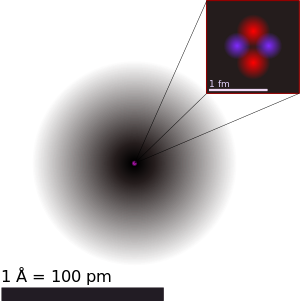
Atomic theory is the scientific theory that matter is composed of particles called atoms. Atomic theory traces its origins to an ancient philosophical tradition known as atomism. According to this idea, if one were to take a lump of matter
and cut it into ever smaller pieces, one would eventually reach a point where the pieces could not be further cut into anything smaller. Ancient Greek philosophers called these hypothetical ultimate particles of matter atomos, a word
which meant "uncut".
In the early 1800s, the scientist John Dalton noticed that chemical substances seemed to combine and break down into other substances by weight in proportions that suggested that each chemical element is ultimately made up of tiny indivisible
particles of consistent weight. Shortly after 1850, certain physicists developed the kinetic theory of gases and of heat, which mathematically modelled the behavior of gases by assuming that they were made of particles. In the early
20th century, Albert Einstein and Jean Perrin proved that Brownian motion (the erratic motion of pollen grains in water) is caused by the action of water molecules; this third line of evidence silenced remaining doubts among scientists
as to whether atoms and molecules were real. Throughout the nineteenth century, some scientists had cautioned that the evidence for atoms was indirect, and therefore atoms might not actually be real, but only seem to be real.

Gas laws
In 1800, Dalton became secretary of the Manchester Literary and Philosophical Society, and in the following year he presented an important series of lectures, entitled "Experimental Essays" on the constitution of mixed gases; the pressure
of steam and other vapours at different temperatures in a vacuum and in air; on evaporation; and on the thermal expansion of gases. The four essays, presented between 2 and 30 October 1801, were published in the Memoirs of the Literary
and Philosophical Society of Manchester in 1802.
There can scarcely be a doubt entertained respecting the reducibility of all elastic fluids of whatever kind, into liquids; and we ought not to despair of effecting it in low temperatures and by strong pressures exerted upon the unmixed
gases further.
After describing experiments to ascertain the pressure of steam at various points between 0 and 100 °C (32 and 212 °F), Dalton concluded from observations of the vapour pressure of six different liquids, that the variation of vapour pressure
for all liquids is equivalent, for the same variation of temperature, reckoning from vapour of any given pressure.