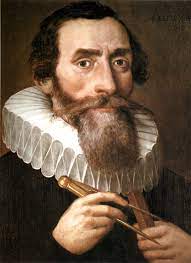
Johannes Kepler (27 December 1571 – 15 November 1630) was a German astronomer, mathematician, astrologer, natural philosopher and writer on music. He is a key figure in the 17th-century Scientific Revolution,
best known for his laws of planetary motion, and his books Astronomia nova, Harmonice Mundi, and Epitome Astronomiae Copernicanae. These works also provided one of the foundations for Newton's theory of universal gravitation.
Kepler was a mathematics teacher at a seminary school in Graz, where he became an associate of Prince Hans Ulrich von Eggenberg. Later he became an assistant to the astronomer Tycho Brahe in Prague, and eventually the imperial mathematician
to Emperor Rudolf II and his two successors Matthias and Ferdinand II. He also taught mathematics in Linz, and was an adviser to General Wallenstein. Additionally, he did fundamental work in the field of optics, invented an improved
version of the refracting (or Keplerian) telescope, and was mentioned in the telescopic discoveries of his contemporary Galileo Galilei. He was a corresponding member of the Accademia dei Lincei in Rome.
Kepler lived in an era when there was no clear distinction between astronomy and astrology, but there was a strong division between astronomy (a branch of mathematics within the liberal arts) and physics (a branch of natural philosophy).
Kepler also incorporated religious arguments and reasoning into his work, motivated by the religious conviction and belief that God had created the world according to an intelligible plan that is accessible through the natural light
of reason. Kepler described his new astronomy as "celestial physics", as "an excursion into Aristotle's Metaphysics", and as "a supplement to Aristotle's On the Heavens", transforming the ancient tradition of physical cosmology by
treating astronomy as part of a universal mathematical physics.

Keplerian telescope
The Keplerian telescope, invented by Johannes Kepler in 1611, is an improvement on Galileo's design. It uses a convex lens as the eyepiece instead of Galileo's concave one. The advantage of this arrangement is that the rays of light emerging
from the eyepiece[dubious – discuss] are converging. This allows for a much wider field of view and greater eye relief, but the image for the viewer is inverted. Considerably higher magnifications can be reached with this design, but
to overcome aberrations the simple objective lens needs to have a very high f-ratio (Johannes Hevelius built one with a 46-metre (150 ft) focal length, and even longer tubeless "aerial telescopes" were constructed). The design also
allows for use of a micrometer at the focal plane (to determine the angular size and/or distance between objects observed).
Huygens built an aerial telescope for Royal Society of London with a 19 cm (7.5″) single-element lens.